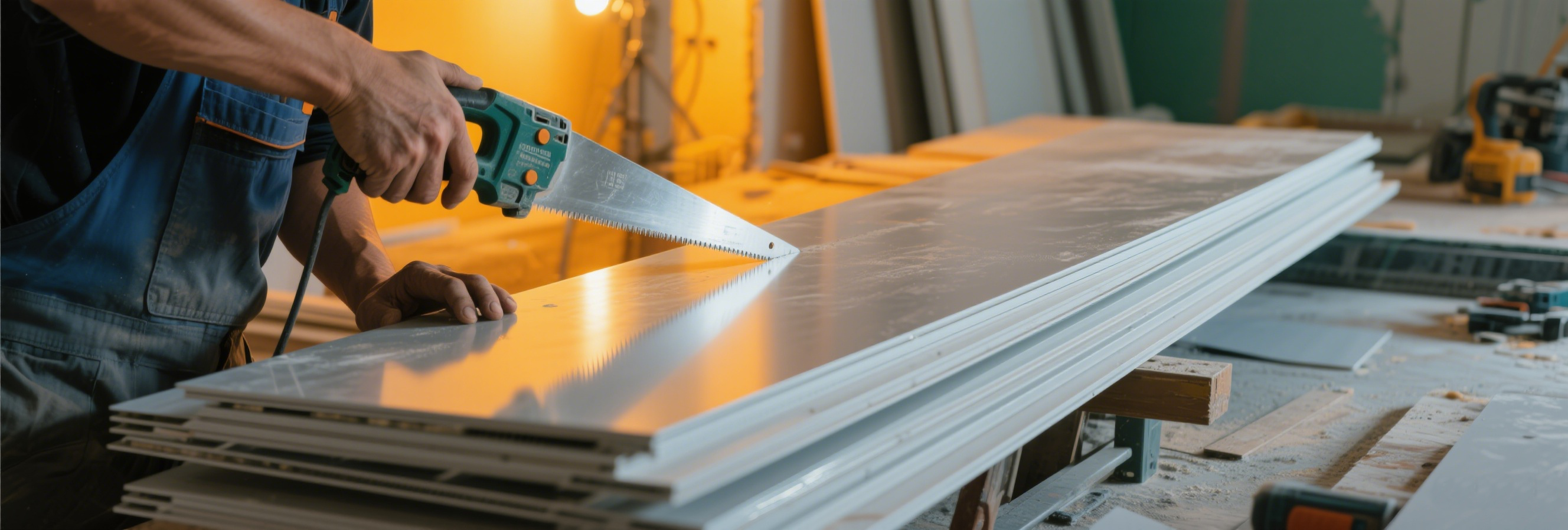

Aluminum-plastic composite panels (aluminum-plastic panels) consist of 0.5mm-thick aluminum sheets on both inner and outer layers, with a 2-5mm thick core in between, and the aluminum sheet surface is coated with a thin fluorocarbon spray topcoat.
Such composite panels feature uniform color and flat surface, and are easy to manufacture. However, they have drawbacks: the middle interlayer contains toxic components, which release toxic fumes when burned or heated to high temperatures, polluting the environment whether used on interior or exterior walls. Additionally, the aluminum sheet and PVC interlayer are bonded by gluing and pressing, resulting in low bonding strength; the aluminum sheet and interlayer can be separated by pulling hard between the two layers.
Moreover, due to the thin aluminum sheets of such composite panels, local heating can easily cause the middle interlayer to expand, making the aluminum sheet bulge outward. From the perspective of curtain wall lightning protection, aluminum-plastic composite panels are made by pressing and bonding two 0.5mm-thick aluminum sheets with polyethylene. Polyethylene is a poor conductor, leaving the two aluminum sheets in an insulated state. Although an aluminum alloy sub-frame is added to the inner layer during production, with rivets and the bent four edges of the panel fixed to connect them, the riveted area is too small. More importantly, the 0.5mm thin aluminum sheet can be penetrated by large lightning current when lightning strikes the curtain wall panel sideways, and the strong current cannot be grounded through the composite panel, leaving the building vulnerable to lightning strikes.
In terms of manufacturing and installation: aluminum-plastic composite panels are first grooved on all four sides, cutting off a certain width along with one side of the aluminum sheet and the plastic layer, leaving only the 0.5mm-thick outer aluminum sheet. The four edges are bent at 90° to form a rectangle, then an aluminum alloy sub-frame of the same size is placed in the rectangular groove of the panel. The bottom of the sub-frame is glued to the back of the panel with adhesive, the bent four edges of the panel are fixed to the sub-frame edges by rivets, and one or more aluminum profile reinforcing ribs are glued in the middle with structural adhesive. However, most current installation units do not follow this method; instead, after grooving, they only bend the edges at 90° and fix them with angle aluminum at the four folded edges. Thus, the panel's own weight and any external forces or loads are borne by the 0.5mm aluminum sheets at the four edges, resulting in low safety.
Any curtain wall is subject to different positive and negative wind loads at all times, and the 0.5mm-thick edges are prone to breakage, a phenomenon that has occurred in most projects. Therefore, aluminum-plastic composite panel curtain walls must be equipped with aluminum alloy sub-frames and reinforcing ribs.
Shandong Lehua Aluminium-Plastic Products Co., Ltd